Weeds Scenery Diary | Fujisato Town, Akita
On my 8th day in Japan, I booked an Airbnb titled 'Room with a goat at the foot of Mount Shirahama' in Fujisato Town, Akita Prefecture. I was drawn by the goat in the title and a photo in the description: four young people lying on a narrow bridge, watching the river below, with layers of green rice paddies behind them.
On my 8th day in Japan, I booked an Airbnb titled 'Room with a goat at the foot of Mount Shirahama' in Fujisato Town, Akita Prefecture. I was drawn by the goat in the title and a photo in the description: four young people lying on a narrow bridge, watching the river below, with layers of green rice paddies behind them.
Akita has a sparse population and rich natural resources. As its name suggests, the main agriculture here is rice cultivation.
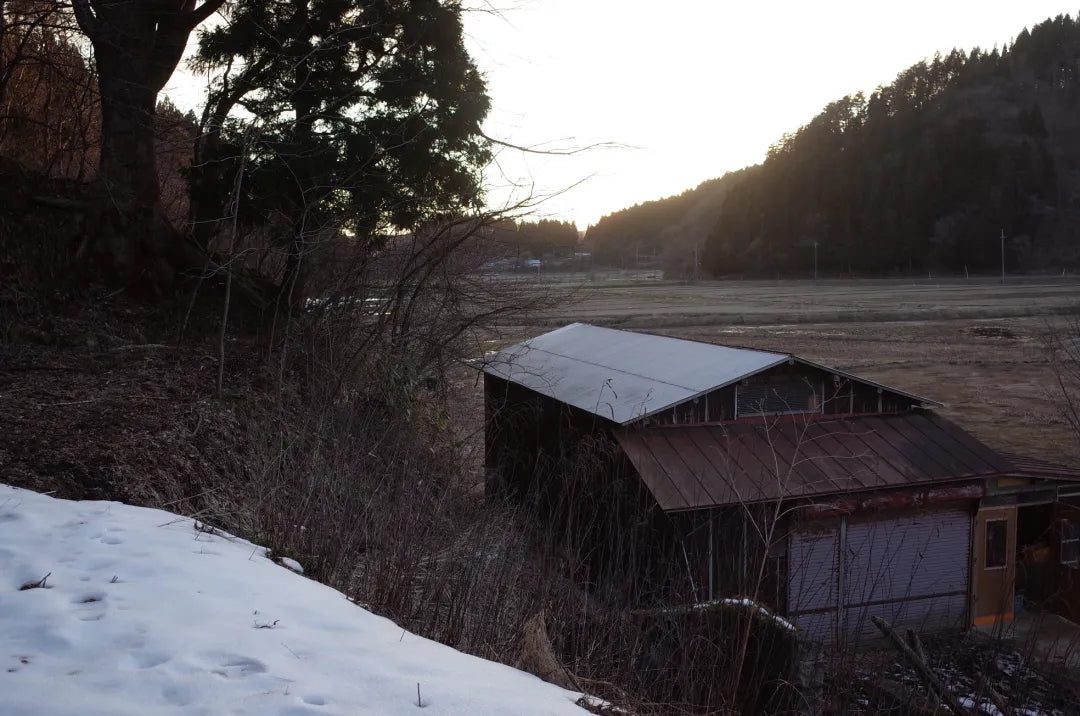
From Hirosaki to Fujisato Town is 80 kilometers. First, a 1.5-hour train ride to Futatsui Station. Along the way, the train passed closely through villages and forests. Everything in the first hour was still covered in snow. The scenery outside the window was no worse than a dedicated sightseeing train.
At some point, the snow suddenly disappeared, revealing the villages and fields. From Hokkaido to Aomori, then to Hirosaki, I had seen a lot of snow along the way. Snowscapes are beautiful, but like sweet ice cream: delicious at first, but tiresome if eaten every day. I really wanted to see the real world without snow.
True to Akita, there were vast fields, but now they were bare, with only cut rice stubble left. In summer, after transplanting rice seedlings, it should look just like the movie 'Little Forest'.
Arriving at Futatsui Station, when the train stopped, I had to press the button beside the door to open it. As I was heading to the exit, the driver leaned out from the cab and called to us, signaling that we needed to hand him our tickets. This was the first time a train driver collected tickets; it felt like true countryside.
Futatsui Station was small, with a waiting room of about 50 square meters and one ticket staff. In the middle of the waiting room was a kerosene heater, making it warm and cozy, like a living room. The walls had posters introducing nearby attractions and seasonal events or festivals. Bicycles were available for rent, but only from April to October.
To reach the guesthouse, we needed to take a bus for a few more kilometers. It wasn't complicated; we could catch it right outside the station.
On the bus, besides Jason and me, there were only two other passengers. After the bus passed the small town near the station, there were no more shops—only wider and wider fields. Ahead of the road was a snow-capped mountain, looking small because of the distance. But though small, it stood out with its silver glow, like a pen drawing. Seeing it, I felt confident I could paint a snow mountain—just trace it as it appeared.
After getting off the bus, we needed to cross a big bridge and then walk a kilometer along a farm road to the opposite village. Jason, using a crutch, stopped in the middle of the bridge, lit a cigarette, and took out his phone to edit a post for his social feed. This behavior indicated his high satisfaction with the place.
Arriving at the guesthouse, we knocked, but no one answered. The door was unlocked, so we poked our heads in and called out. Finally, a young man came out with a confused look, as if he had no idea about our arrival. I showed him my booking on my phone and stammered for a while.
'Ah, duozhu!' he suddenly realized.
Our room was on the second floor, with two bunk beds. After settling our luggage, we felt hungry. That's when I realized I hadn't considered dinner. Opening the map, the nearest restaurant and store were 4 kilometers away. There were no taxis, and the bus required a phone reservation. A 4-kilometer walk was fine for me, but not for Jason with his crutch.
In a pinch, I opened a translation app and went downstairs to ask the young man (his name is Tagaya) for help.
Our entire conversation was typed, without speaking.
Me: 'Excuse me, can I order dinner here?' I thought, since there were no restaurants nearby, he must have to eat dinner himself, right?
Tagaya: 'You can eat, but you need to go buy groceries.'
Me: '...' The translation might not be accurate, but it seemed we couldn't mooch a meal.
Me: 'Then, can I rent a bicycle here?'
Tagaya: 'Uh... I can call a friend to ask.' He thought for a moment, then went to the kitchen to call his friend.
While he was on the phone, I looked around. Strangely, there was no trace of a goat.
Tagaya: 'Sorry, I couldn't arrange a bicycle for you.' After the call, he looked away with an embarrassed apology.
Me: 'No problem. And where is the goat?'
This question seemed to stump him again. He scratched his head for a while, then opened Google Maps and pointed to a spot, which from the kanji seemed like a ranch, but not nearby.
Tagaya: 'Do you want to see the goat?'
Me: 'Yes, but it seems far. Maybe not.' I cared more about food than the goat.
Tagaya: 'Besides seeing the goat, do you want to go anywhere else?'
Me: 'I also want to go to the supermarket to buy food for the next two days.'
Tagaya: 'Maybe I can drive you to see the goat, and stop at the supermarket on the way. An extra 1000 yen for the room fee, okay?'
Me: 'Okay!' 1000 yen is about 50 RMB, and considering Japanese taxi prices, he was purely kindhearted.
Proudly, I told Jason the good news that we had a ride. We got into Tagaya's small black minivan. The van felt familiar, but Tagaya's was clean and tidy. From Hokkaido all the way south, whether rural or urban, everyone seemed to love minivans; even many sedans were made square and round, very cute.
Sitting in the back, Jason and I were like city folk visiting the countryside for the first time, 'oohing' at ducks by the roadside (especially Jason). Tagaya, silent and shy, didn't say a word. But when Jason 'ooh-ed', I saw Tagaya smile secretly in the rearview mirror.
The minivan drove through fields toward the mountains. The road wound, flanked by straight cedar trees. Jason and I 'ooh-ed' again because it really looked like the movie 'Wood Job!' Akita cedars are famous; Akita cedar is known as one of the 'Three Great Beautiful Cedars of Japan.'
We felt that even if we didn't see the goat, just riding in Tagaya's minivan for a spin in the mountains was satisfying enough.
At the ranch, Tagaya told us he wasn't familiar with the place and needed to ask if we could go in and see the goats.
The ranch was a long wooden bungalow with windows. Standing on tiptoes, I could barely see the goats inside. I told Tagaya I had seen them, but he still wanted to take us in.
Seeing the sheep up close, the first image that came to mind was the sheep man from Haruki Murakami's novels. After seeing real sheep with dirty wool, the image became more vivid. This was my first time seeing real sheep. Jason said that in Japan, sheep are exotic and not common. No wonder there's 'A Wild Sheep Chase'.
But one thing puzzled me: why was the goat so far away when the listing said 'house with a goat'? And Tagaya said he wasn't familiar with the place—he didn't seem like someone who would use goats as a gimmick to deceive.
On the way back, we stopped at the supermarket. Though the town was small, the supermarket was well-stocked, with many ready-to-eat items and several choices of sashimi. Jason and I wanted this and that, and ended up with two big bags. Our worries were over.
Back home, we divided the food into 'eat immediately' and 'eat slowly' piles. We laid out the former for a meal and put the latter in the fridge.
Tagaya's kitchen was spotless. In fact, all the places we'd stayed were immaculate. Judging by the fridge, he didn't cook much. Now I understood when he said we'd need to buy groceries.
While we sorted food, Tagaya busied himself lighting the sunken hearth in the middle of the living room. The hearth resembled a Tibetan stove but more delicate. After setting the food, I sent Jason to invite Tagaya to join us. I thought shy him wouldn't come. But he said, 'Ah, really?' and followed Jason.
Jason speculated, 'Maybe he didn't know how to refuse.' Anyway, we ended up eating together.
I still wanted to know about the goat in the listing, so I couldn't help taking out my phone.
Me: 'I saw the listing mentions a goat. Did you raise goats before?' To be safe, I typed 'goat' in Japanese.
Tagaya: 'I raise goats, about five minutes from here. I'll go feed them later. Do you want to come?'
Me: '...Yes.'
He had goats, yet drove us to that faraway ranch. Why? Could it be because I asked 'Where is the goat?' and he scracthed his head, thinking I meant baby goats? He probably thought I wanted to see young goats, not his adult ones. Haha, that's adorable. I felt sorry but amused.
It turns out that in Japanese, if you say 'sheep' alone, they might specifically mean 'sheep'. 'Goat' is a different word. In Chinese, 'sheep' can cover both. And I shouldn't have added 'small' before 'goat'.
During dinner, we kept typing what we wanted to say and translating for each other. Jason wanted to know if Tagaya was married, but I thought it inappropriate. So we asked, 'Do you live here alone?' He also asked us why we came, etc.
Finally, he asked, 'Can two of my friends come over tonight to talk?' We said okay.
So despite being shy, he wasn't antisocial.
We went to feed Tagaya's goats.
Before leaving, Tagaya changed clothes—probably his goat-feeding outfit—and grabbed a pair of gloves from his small pickup truck parked at the entrance. Then he drove us in his black minivan. This time we went straight up the mountain road behind the house, arriving in five minutes. It was a simple goat shelter made of wood, at the foot of the mountain. Next to it was a big chestnut tree with many leftover chestnut husks from autumn, plus a small patch of unmelted snow.
When Tagaya opened the goat shelter, three goats had already escaped into the hay storage room. They were white and pink, beautiful. Compared to the gray-wooled sheep at the ranch, these three were like princesses. Tagaya gave me some cabbage leaves to feed them. As I fed them leaf by leaf, they tilted their heads proudly, as if saying, 'Aren't I cute?' After I fed the specified amount, he even thanked me.
Around 7:30 PM, Tagaya asked, 'My friends, can they come now?'
'Sure!' we replied.
Tagaya's friends were a couple in their thirties (actually forties). The man was Yasu, the woman Megumi. They lived next door, a minute's walk away. When Megumi entered, she said, 'Can you speak English?' Tagaya muttered something in Japanese; Jason said it meant 'a sigh of relief.'
But Megumi's English wasn't great either (nor was mine). To facilitate communication, Jason simplified his sentences in his mind before speaking, becoming slightly stuttery. He also imitated Japanese intonation. This leveled everyone's language skills. Jason was thoughtful. Later, he even mixed Japanese words into his English—a good chance to practice.
We talked about anime and our jobs. Yasu was a jockey, Megumi a boxing coach. But Megumi looked gentle, not like a typical boxer. They had returned to help with the family candy business.
Tagaya had told Jason earlier that he did some farming. Curious, I asked what he grew. Tagaya asked if we wanted to see. So we put on shoes and went into the next room through a door. It was an unexpected cultivation room. Tagaya grew microgreens for salads. I hadn't noticed them before, but a few days ago at an izakaya, I had them in a snack.
The room was like a micro-plant lab, with strict temperature and humidity. There was a blackboard for records. Beside the plants were sticky traps that had caught many small black bugs. Each pot of microgreens looked like a miniature bonsai, adorable. A few pots with yellowish leaves were in a special area, seemingly being rescued. Tagaya brought a tiny pair of scissors, and from pots not needing rescue, he cut two varieties for us to taste.
That night, at the end of the chat, Yasu and Megumi asked, 'If you're free tomorrow night, can we come again? If you have time.' 'Sure!' Jason replied.
Interaction with people is important during travel; it directly affects how we feel about a place. Chatting like this, gradually learning about their lives, naturally created a bond. It made me want to come back again.
The next day, we hiked toward the goat shelter. The night before, after hearing I liked mushroom picking, Megumi showed a picture of a spring wild vegetable called 'fuki' (butterbur). It was so unique that I remembered it. On the hike, I found them in a grassy slope. I looked them up—they are butterbur, a Asteraceae plant with a chrysanthemum fragrance. Then the whole hike turned into a wild vegetable picking activity.
Once home, I confirmed with Tagaya and asked if he wanted to eat them with us for dinner. He said yes.
Since I picked quite a lot, I blanched half and dressed with hot oil for a cold dish. The other half I chopped and stir-fried into fried rice. Honestly, it wasn't tasty—a bit bitter. Jason ate two bites and stopped, translating 'tastes like medicine' for Tagaya. But Tagaya seemed to like it, constantly taking more; if he hadn't left some for me, he might have finished the whole plate.
Later, at Akita's Shinkansen station, I bought a bottle of miso paste made with butterbur. After returning to Dali, I tried it—not bitter at all, delicious. I regretted not buying more. Later, while reading about Akita, I was surprised to find that the Akita prefecture stamp features the butterbur plant.
This is a log-like travelogue, and it turned out so long.
Perhaps the feeling of traveling is like being newly in love—even the slightest touch makes the heart race. Maybe it's because we need such magnified feelings that we travel.
March 2024
Photos

Continuer à lire
3
Jason | Using AI to Create Your Own Mini Program/Website
Two months ago in Chiang Mai, I stumbled upon the chance to start learning how to build mini programs. My AI programming mentor, Wangshen, told me, 'Once you finish your mini program, write a summary report.' Now I've completed the new mini program for Cangshan Hiking Home, and it's already being tested. It not only solves problems I've wanted to address for a while, like adding age tags to filter activities and providing an English version, but it has also introduced new features, such as browsing restaurants, guesthouses, and meeting points on a map for a more intuitive experience, and using AI to provide quite intelligent responses.
Learn AI Programming Together
Some information about AI programming
Celebrate the Torch Festival in a Nanzhao Royal Clan Village
Over the past two years, we have taken guests to celebrate the Torch Festival in Songhe Village, Eryuan. Together we slaughtered a sheep, and with the whole village, erected a huge torch in the center of the village square. Everyone made their own torches from hemp stalks, and together with the older and younger villagers, we rushed to grab the blessing baba (cakes) from the big torch, passing blessings to each other with fire. Even for me, a native Bai person, these are rare and precious traditional festival experiences. Dali has endless festivals, and I want to experience them more before they fade away. I remember the Torch Festival of my childhood: torches were no longer enough for me. Before the festival, I would tell my dad to prepare a bucket of waste engine oil and diesel, mix them together, and then I would tightly bind cotton and old cloth with rope into a ball (some kids would secretly take cotton from their quilts at home to make it). Finally, I would make an iron wire ball, soak it in the bucket of oil, and secretly take it out every day to look at it, looking forward to having a great time on the day of the Torch Festival. We would compete in the village and by the rice fields to see whose fireball or torch was more impressive. When the torches and fireballs were almost burned out, we would rush home, walk around the potted fruit trees in circles, and say blessing words, hoping they would grow even better in the coming year.