Jason | "Zayaa" and "Shanxia"
In the current construction of the 'Cangshan Hiking Home' group, I've gained new insights on 'freedom': not only the freedom to leave, but also the ability to be 'free' when leaving.
Two weeks ago, on an afternoon, I drove my van, with Zamao and Lucky, from Dali Ancient City back to my home in Wanqiao. This town I live in is 15 kilometers north of Dali Ancient City, passing through Yinqiao Town. Aruna's Zayaa Cafe is just a short drive north from the ancient city along Dali Road, turning into Xiaocen Village. I thought I'd drop by; if she was there, I could give her the prepared 'Partner Plan' table cards.
At the start, I planned to begin with the team leaders' own studios, starting from small goals.
The cafe was at the village entrance, the door closed, and Aruna wasn't home. The taro in the field by the door had grown tall, a lush green. Last April, she was still hesitating about whether to take this place and do something with it. After we met a few days later and agreed that she would try flower pastry baking, she decided to transform it into a studio.
Before becoming 'Aruna who can do everything,' she graduated in sociology, then stayed in Shanghai taking care of her cats and dogs. When she needed to support herself, she relied on her knowledge of cats and dogs to work at a pet store. After moving to Dali, she rented land, built a house, and raised chickens, but it wasn't easy, and policies had restrictions. She once worked at Pirate Wine Castle, which is where I first met her about 8 years ago. Later, she tried organizing long-distance travel routes, converted a van for long-distance camping trips, and sold road coffee. Then she learned baking and opened a bakery. During the pandemic, she spent some time working in Thailand. It's hard for me to sort out the timeline; once at the end of a conversation, she said, 'I like exciting and adventurous things.' She dares to make decisions, sometimes for survival, sometimes for life experiences.
The day before yesterday, it rained all day. Old Li and I were sitting in the kitchen chatting, and Aruna came over in the evening to hang out, bringing some zongzi. After eating the zongzi, she went to the living room to use my automatic massage chair. After the massage, she said, 'Once I pay off my debts, I'll buy one too.' She still hasn't paid off the loans for transforming her studio and guesthouse.
Seeing Zayaa's door closed, I didn't stop; I drove on slowly, through the village streets, back to Dali Road. The next stop was Li Zhenhao's newly opened 'Shanxia Nature Studio'.
Last September, after our busy summer season, Aruna, He Chen, and Li Zhenhao started running Zayaa Cafe together. Aruna made bread, Li Zhenhao made coffee and later also offered specimen-making classes, and He Chen served community lunches. During the off-season, everyone was free; I often went there for coffee, chats, lunch, and sometimes stayed for dinner. It was often lively. One time, Chunyu cooked there, and many people ate together; we spent many wonderful moments there. Several times after leading tours together, even though tired, we would instinctively head back to Zayaa to sit for a while. (A record from the end of last year: Zayaa)
After half a year like this, one day He Chen decided to stop the community meals, and Li Zhenhao started looking for a place to set up an independent studio that could also serve as a residence. The trio's Zayaa period ended, the bustling cafe was no more. Many might feel regret, but I don't entirely think that way. I don't even want to know the reasons for the disbandment, because it's not such a bad thing.
Once during a chat, Li Zhenhao said, 'After coming to Dali and doing what I do now, for the first time I feel I can survive without relying on a system (meaning working in a company). That feeling is really good.'
People can only walk together for a stretch, no matter how long; eventually they part ways. Maybe they'll travel together again later, but that's another matter. I've always believed that freedom is the ultimate goal. Since everyone is different, with different thoughts and new feelings at different times, it's hard to stay together forever unless there's a compelling reason to compromise. Now, everyone is freer and has a period to remember.
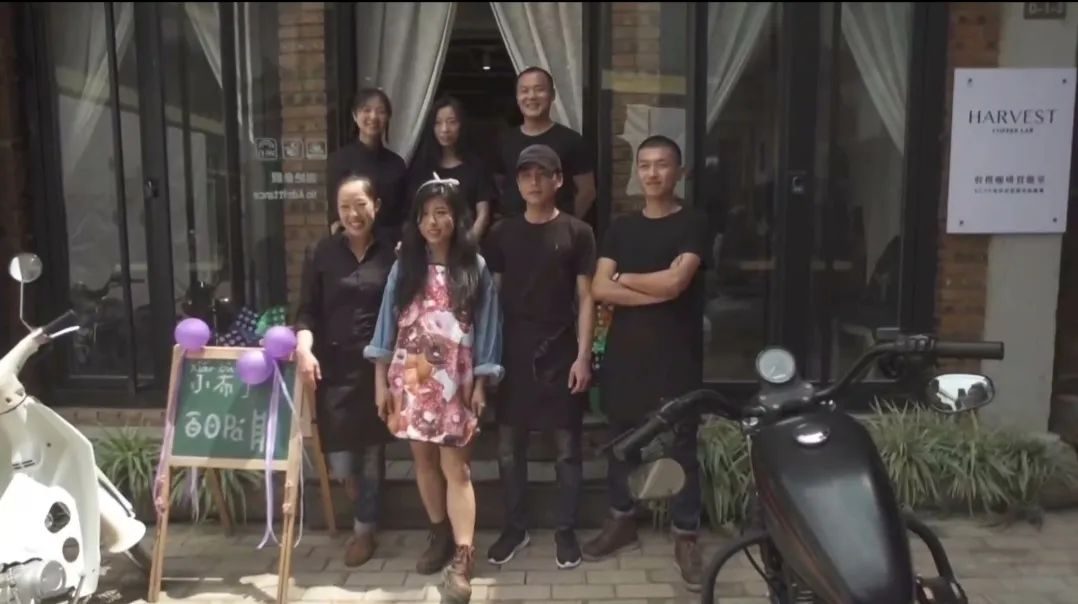
In March, Cheng Chang sent me a video from the past, from which I captured this photo. He was probably organizing old materials and sent it to me, perhaps out of sentiment about time: 'You were so thin back then, Dahai too. I'm still fat as always.'
Seeing this video, I suddenly thought of something and asked him which year it was. 'April 2016' – it was Buding's 100-day party, so he remembered.
Yes, that was the peak period of Late Night Diner. In the video, Xiaochun, Huahua, Tailor, and Yangliu were all there. The reputation was good, business was booming. Tailor was in charge of dine-in, Xiaochun handled takeout; everything was developing, with many talents. However, a few months later, Tailor left to open his own 'Tailor's Home' ramen shop, Xiaochun left to prepare for his own 'Chun Road Tavern', and Xiaofeng and Yangliu left one after another. He Chen, who had only been there a few months, took over managing Late Night Diner in a daze.
Actually, leaving didn't necessarily mean better income, but each person has their own stage and psychological needs. Just as Xiaochun said when he left the first time (this is the second time), 'I can't keep cooking in the kitchen forever.' If joining 'Late Night Diner' gave him something to do and kept him in Dali at first, later new life confusions would arise. Tailor also had a force pulling him to start his own business.
Xiao 6 has left and returned to 'Late Night Diner' at least four times. She worked in Shanghai, traveled around, and intermittently came back to work. Now she takes photos for tourists by Erhai Lake. He Chen and I both asked if she wanted to lead tours, but she said no.
From past experiences, what I've realized is that the separation of two people or a group involves many factors beyond personal control. You can only do your part, and even you yourself might want to leave, and eventually it all disperses. 'Cangshan Hiking Home' will be no exception.
Back then, based on a simple notion of 'freedom,' I didn't mind someone leaving because it was a personal choice. Additionally, since everyone could handle almost all the work in the shop—shopping, preparation, taking orders, cooking, cleaning, inventory—operations didn't have major problems and didn't heavily rely on any individual.
But now, in the construction of the 'Cangshan Hiking Home' group, I've gained new insights on 'freedom': not only the freedom to leave, but also the ability to be 'free' when leaving. Li Zhenhao said, 'Being able to survive outside the system' is a great feeling. So I shouldn't build a new unfree system; instead, I hope to create a large system composed of multiple 'small free systems'—they can join together or leave for other needs. Together we are stronger, but leaving can also sustain survival, even if a bit harder; that's the price to pay for freedom. Most importantly, if you have the ability to leave, then staying will be sincere.
This idea came to me after last summer's busy season. I mentioned it in 'Crossing the Baishi Stream' in early September last year, and now I'm practicing and refining it. Starting with each group setting up their own official accounts on WeChat and Little Red Book, registering their own entities, opening new routes, writing their own route descriptions, scheduling activities, and a month ago, we stopped comprehensive customer service; each group now directly connects with guests, arranges orders, and manages staff: basically operating independently. With time and accumulation, they can form their own complete structure.
Li Zhenhao's 'Shanxia Nature Studio' is at the foot of Wushan Mountain, in the village's last row near the mountain. She spent over two weeks renting the shop, renovating and decorating. It includes a cafe, a workspace, and a small bedroom. It wasn't renovated before, so she must have learned a lot. Also, A'jie's family introduced and helped, which saved some worry. Seeing her become more independent is heartening.
When I arrived, the door was closed. Xiao Qi was sitting at the entrance. He said he had just finished leading a group down the mountain and came over to sit. Li Zhenhao said she would be down in fifteen minutes—she had started a Dragon Boat Festival activity making wormwood door hangings and had taken guests up the mountain. I sat down beside Xiao Qi, and he poured me some iced tea and gave me some fruit, leftovers from the afternoon tea prepared for the group. We sat at the door chatting while waiting, in no rush. Xiao Qi worked at Late Night Diner for quite a while and is also a close friend of He Chen. He recently returned from Shanghai or Beijing, where he did game modeling and got bored. Now he is slowly starting to lead tours with He Chen. He knows a lot about plants, animals, and insects, so it won't take him long to adapt to this new job.
After several 'fifteen minutes,' Li Zhenhao still hadn't returned. I guessed she must be having fun, picking this and that. That's a good trait of a leader—when they enjoy it themselves, they get more excited than the guests.
When she finally arrived, it was nearly dark. I gave her the table cards, and she quickly made me a coffee. After drinking it, I went home.
If I have the motivation to do ground promotion like the 'Partner Plan,' it's largely because of Aruna, Li Zhenhao, Xiao Qi, He Chen, and the other companions. I hope that before the final dispersal comes, we can move forward more healthily for a while and have more time to do things together. In the future, these processes and memories will be the most precious part.
Photos and videos
WeChat article · WeChat article
続けて読む
3
Jason | Using AI to Create Your Own Mini Program/Website
Two months ago in Chiang Mai, I stumbled upon the chance to start learning how to build mini programs. My AI programming mentor, Wangshen, told me, 'Once you finish your mini program, write a summary report.' Now I've completed the new mini program for Cangshan Hiking Home, and it's already being tested. It not only solves problems I've wanted to address for a while, like adding age tags to filter activities and providing an English version, but it has also introduced new features, such as browsing restaurants, guesthouses, and meeting points on a map for a more intuitive experience, and using AI to provide quite intelligent responses.
Learn AI Programming Together
Some information about AI programming
Celebrate the Torch Festival in a Nanzhao Royal Clan Village
Over the past two years, we have taken guests to celebrate the Torch Festival in Songhe Village, Eryuan. Together we slaughtered a sheep, and with the whole village, erected a huge torch in the center of the village square. Everyone made their own torches from hemp stalks, and together with the older and younger villagers, we rushed to grab the blessing baba (cakes) from the big torch, passing blessings to each other with fire. Even for me, a native Bai person, these are rare and precious traditional festival experiences. Dali has endless festivals, and I want to experience them more before they fade away. I remember the Torch Festival of my childhood: torches were no longer enough for me. Before the festival, I would tell my dad to prepare a bucket of waste engine oil and diesel, mix them together, and then I would tightly bind cotton and old cloth with rope into a ball (some kids would secretly take cotton from their quilts at home to make it). Finally, I would make an iron wire ball, soak it in the bucket of oil, and secretly take it out every day to look at it, looking forward to having a great time on the day of the Torch Festival. We would compete in the village and by the rice fields to see whose fireball or torch was more impressive. When the torches and fireballs were almost burned out, we would rush home, walk around the potted fruit trees in circles, and say blessing words, hoping they would grow even better in the coming year.